YIPA
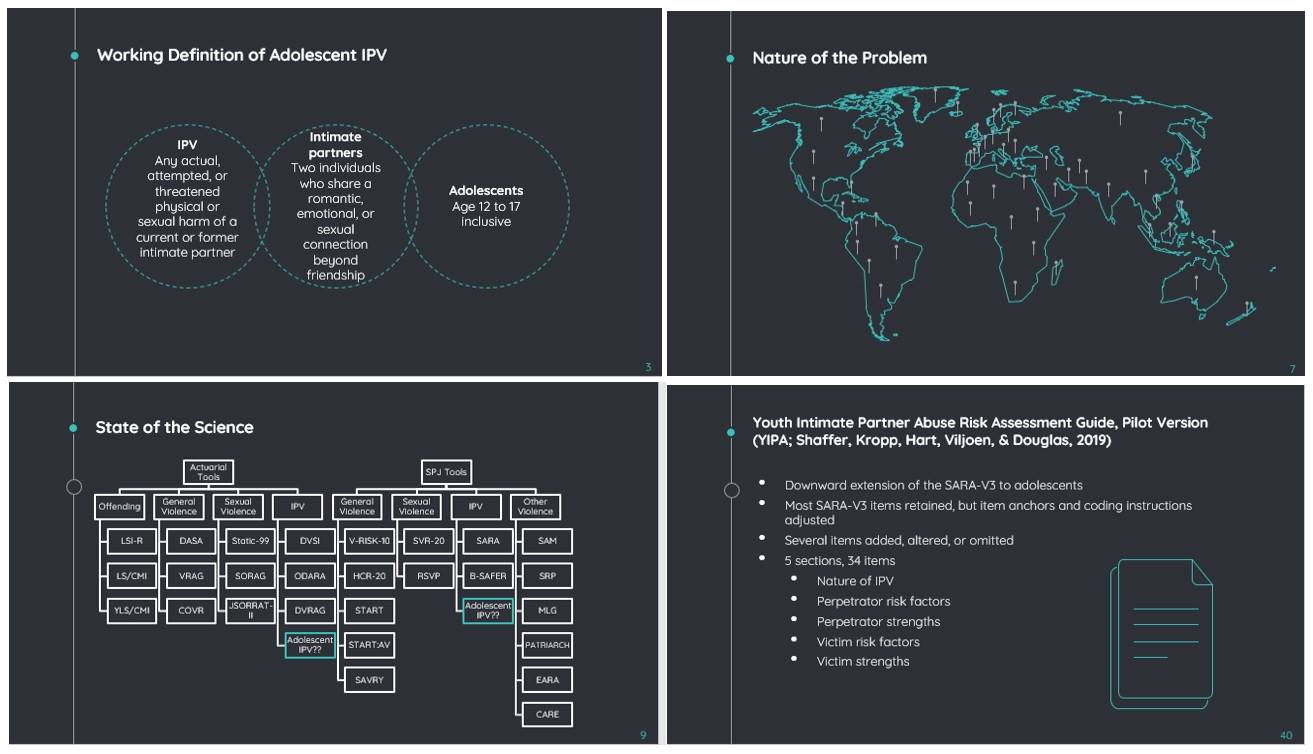
The Youth Intimate Partner Abuse Risk Assessment Guide (YIPA) is a structured professional judgment tool developed to assess and manage the risk of intimate partner violence (IPV) among adolescent males and females aged 12 to 17 years.
The YIPA is an adolescent adaptation of the Spousal Assault Risk Assessment Guide, Version 3 (SARA-V3), a widely used IPV risk assessment instrument among adults. While the YIPA retains the foundational structure of the SARA-V3, its item anchors and coding instructions were revised to reflect how the original risk factors may present in adolescents. Additional modifications were made to accommodate developmental differences, including the addition, removal, or revision of specific items.
The YIPA comprises five domains:
- Nature of IPV – Six factors describing the characteristics and severity of the adolescent’s IPV behavior.
- Perpetrator Risk Factors – Twelve factors pertaining to individual and contextual risk factors associated with the perpetrator.
- Perpetrator Strengths – Five protective factors that may mitigate risk among the perpetrator.
- Victim Risk Factors – Six individual and contextual risk factors that may increase the vulnerability of the victim.
- Victim Strengths – Five protective factors associated with resilience and safety of the victim.
The development of the YIPA was undertaken as part of Dr. Catherine Shaffer’s doctoral dissertation, which also empirically established the need for an adolescent-specific IPV risk assessment and management framework. The project was supported by Drs. Randy Kropp, Stephen Hart, Jodi Viljoen, and Kevin Douglas. Dr. Shaffer’s dissertation was recognized with awards from the American Psychology-Law Society and the Canadian Psychological Association, and was nominated for the ProQuest Distinguished Dissertation Award for the best Ph.D. dissertation in Canada in the fine arts, humanities, and social sciences.
At present, the YIPA has not yet been released for clinical or professional use. Plans are underway to extend its applicability to emerging adults (ages 18–25) through a forthcoming tool: the Youth and Emerging Adult Intimate Partner Abuse Risk Assessment Guide (YEARPA).
Reference
Shaffer, C. S., Kropp, R., Hart, S, Viljoen, J. L., & Douglas, K. S. (2020). Youth Intimate Partner Abuse Risk Assessment Guide: Pilot Version User Manual. Simon Fraser University and Protect International Risk and Safety Services, Inc.
Publications on the YIPA
Shaffer, C. S., Viljoen, J. L., & Douglas, K. S. (2022). Predictive validity of the SAVRY, YLS/CMI, and PCL:YV is poor for intimate partner violence among adolescent offenders. Law and Human Behavior, 46, 189-200. doi:10.1037/lhb0000483
Shaffer, C. S. (2020). Adolescent intimate partner violence: The case for outcome-specific and developmentally informed guidelines to evaluate and manage risk. Department of Psychology, Simon Fraser University.
Presentations on the YIPA
Shaffer, C. S., Douglas, K. S., & Viljoen, J. L. (2022, March). Adolescent intimate partner violence: The case for outcome-specific and developmentally informed guidelines to evaluate and manage risk. Invited poster presented at the Annual Meeting of the American Psychology – Law Society, Denver, CO (2021 American Psychology-Law Society Dissertation Award Winner).
Shaffer, C.S.,Douglas, K.S. & Viljoen, J. L. (2018, October). Risk assessment of dating violence among youth: Challenges and directions forward. Poster presented at the Annual Meeting of the Canadian Association of Threat Assessment Professionals, Whistler, BC.
Shaffer, C. S., Viljoen, J. L., & Douglas, K.S. (2018, October). A systematic review of risk factors and protective factors associated with adolescent dating violence. Poster presented at the Annual Meeting of the Canadian Association of Threat Assessment Professionals, Whistler, BC.
Shaffer, C. S., Gray, A. L., Viljoen, J. L., & Douglas, K. S. (2016, June). Are adolescent risk assessment tools useful for predicting dating violence? A prospective investigation of the Youth Level of Service/Case Management Inventory and Structured Assessment of Violence Risk in Youth. Paper presented at the 16th Annual International Conference of Forensic Mental Health Services, New York, NY.
 Dr. Catherine Shaffer